
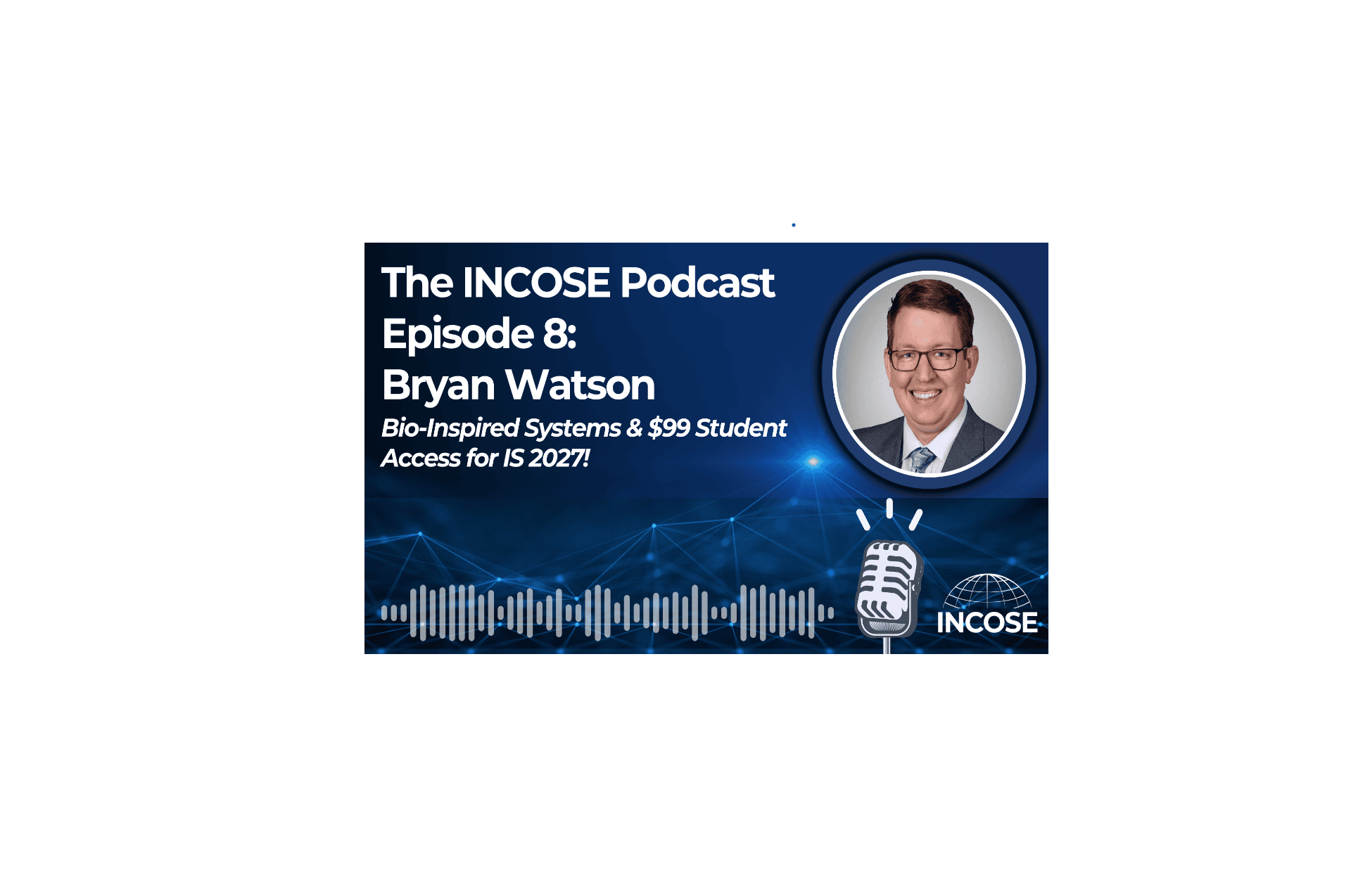
In the latest episode of the official INCOSE podcast, we sit down with Dr. Bryan Watson—Assistant Professor at Embry-Riddle Aeronautical University, founder of the Biologically Inspired Design-for-Resilience (BID4R) Lab, and Chair of the INCOSE IS Technical Program Committee.
From serving on nuclear submarines in the U.S. Navy to studying how Amazon River turtle eggs communicate to hatch in sync, Dr. Watson shares how natural behaviors can transform the way we architect artificial systems, drone swarms, and supply chains for maximum resilience.
Highlights From the Episode:
- Submarines to Systems: How eight years in the Nuclear Navy, including submarine service on the USS Louisville and with the Naval Prototype Training Unit, shaped Dr. Watson’s perspective on complex socio-technical systems and real-world resilience.
- Bio-Inspired Design: Why nature is inherently resilient and how studying turtle egg communication, ant reallocation, and natural swarms helps engineers design resilient algorithms without adding costly hardware.
- Systems of Systems Emergence: Why resilience is particularly challenging across interacting complex systems, and how low-level behavioral shifts drive system-wide adaptability.
- IS 2027 Preview & $99 Student Access Tier: An insider look at what the Technical Program Committee is cooking up for IS 2027 in Washington, D.C., including the brand-new $99 Student Access-Only Registration Tier (150 seats, lottery opens soon!).
Don’t miss this inspiring discussion on the future of systems engineering education, bio-inspired design, and conference engagement.
Listen to the full episode on the INCOSE Podcast webpage or wherever you get your favorite podcasts.
“There’s good evidence that nature is inherently resilient because everything’s still alive… If we can find these behaviors at a lower level which promote desirable system-level behavior in nature, then we can transfer them to an artificial system to make it more resilient.” – Dr. Watson